

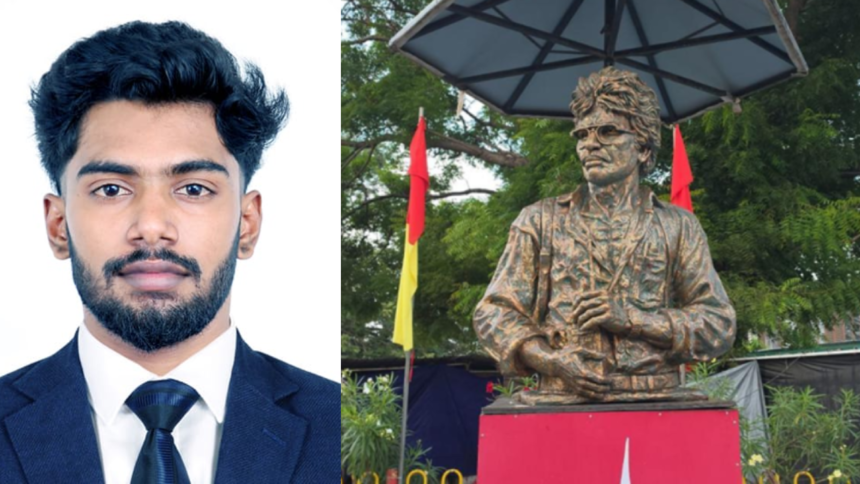
A government may have the power to remove a statue, but it does not have the power to erase a people’s history, silence their memories or extinguish their demand for justice – By Kabilesh Mylvaganam
Sri Lanka, formerly known as Ceylon under British colonial rule, has experienced numerous changes of government, political leadership and constitutional arrangements since independence in 1948. Yet one of the country’s most enduring political questions remains unresolved: the rights, dignity and political future of its Tamil people. For nearly seven decades, successive governments have promised national unity, reconciliation and equality, but the lived experiences of many Tamils suggest a troubling gap between political promises and meaningful change. The reported removal of a memorial statue honouring Rasaiah Parthipan, widely known as Thileepan, in Nallur, Jaffna, in September 2026 has once again exposed the deep divisions between the Sri Lankan state and the Tamil community. What may be presented by the authorities as a matter of law and public order carries a far more painful meaning for Tamils in Sri Lanka and across the world. It raises a fundamental question: if political leadership has changed repeatedly since 1956, why do the grievances that shaped the Tamil struggle remain so persistent?
The ethnic conflict in Sri Lanka did not begin with the anti-Tamil violence of July 1983, nor did it emerge simply from the armed struggle that followed. Its political foundations can be traced to the years after independence, particularly the introduction of the Official Language Act of 1956, commonly known as the Sinhala Only Act. By making Sinhala the sole official language, the government institutionalised a policy that many Tamils regarded as a direct attack on their equal status as citizens. The consequences extended beyond language. Access to public employment, administration and political participation became increasingly contentious, while Tamil demands for federalism and regional autonomy encountered sustained resistance. Although subsequent reforms recognised Tamil as an official language, the sense of exclusion created by earlier policies was never fully overcome. The violence of 1958, 1977 and 1983 further undermined Tamil confidence in the state’s willingness to guarantee their security and rights.
It is important to remember that Tamil political resistance did not begin with weapons. Tamil leaders initially sought change through parliamentary democracy, peaceful demonstrations, negotiations and nonviolent civil disobedience. Their demands were rooted in the belief that a multilingual and multiethnic country could not achieve genuine national unity without political equality. However, repeated failures to reach lasting constitutional settlements, combined with communal violence and discrimination, contributed to the emergence of several Tamil militant organisations during the 1970s. Among them, the Liberation Tigers of Tamil Eelam (LTTE) eventually became the dominant armed movement, continuing its campaign for an independent Tamil homeland until its military defeat in May 2009.
The life and death of Thileepan occupy a particularly significant place in this history. Born Rasaiah Parthipan, he was a political representative of the LTTE who undertook a hunger strikein September 1987, following the Indo-Sri Lanka Accord. His protest was directed principally towards the Indian government and its failure, in his view, to address Tamil political and security concerns. His demands included the release of political detainees, an end to statebacked Sinhala settlement in Tamil-majority areas and measures concerning security forces and policing. Beginning his fast on 15 September near the Nallur Kandaswamy Temple in Jaffna, he refused food and water until his death on 26 September, aged just 23. His final protest, carried out without a weapon, became a lasting symbol of sacrifice for many Tamils. Although Thileepan belonged to an organisation engaged in armed conflict, the method of his final protest evoked the tradition of nonviolent resistance associated with Mahatma Gandhi.

Nearly four decades later, the memory of that hunger strike continues to resonate. The removal of Thileepan’s statue from Nallur in September 2026, shortly after the anniversary of his death, has therefore caused considerable distress among those who regard him as a symbol of Tamil political resistance. Sri Lankan authorities have defended the removal on legal grounds, referring to restrictions concerning the promotion of the LTTE, which remains a proscribed organisation. However, the existence of such restrictions does not eliminate the responsibility of the state to respect freedom of expression, peaceful remembrance and the cultural rights of minority communities. There is a fundamental distinction between advocating violence and commemorating a historical figure whose death has become part of a community’s collective memory. A government genuinely committed to reconciliation should be capable of recognising that distinction rather than allowing every expression of Tamil remembrance to become a confrontation with the state.
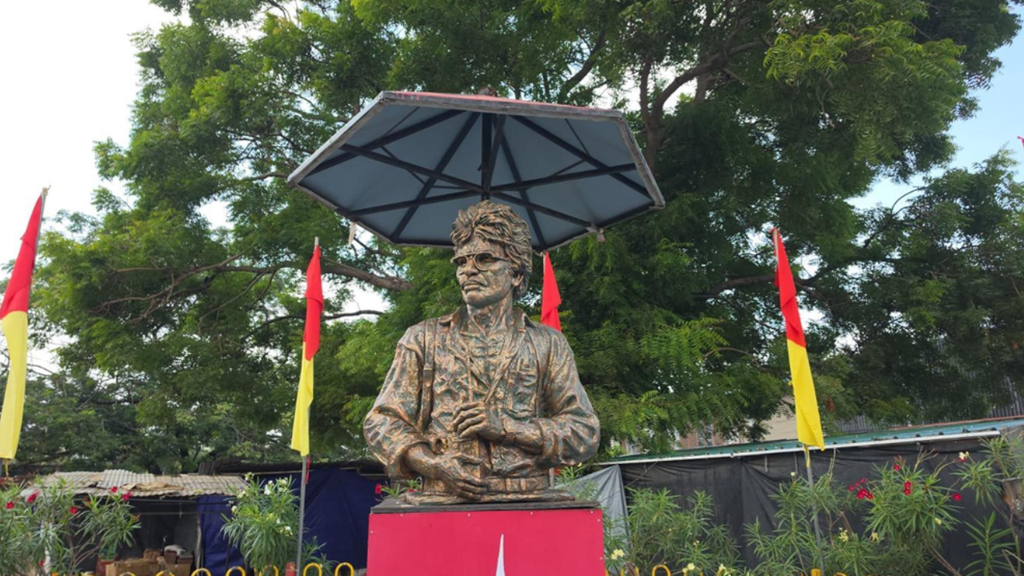
The removal also raises questions about the political direction of Sri Lanka’s current government under President Anura Kumara Dissanayake and the National People’s Power coalition. The Janatha Vimukthi Peramuna, a central force within the coalition, has its own history of confrontation with the Sri Lankan state. Its supporters experienced severe repression during earlier uprisings, particularly in the late 1980s, when thousands of people were killed or disappeared amid political violence and counterinsurgency operations. That history should provide the present leadership with a profound understanding of the consequences of excessive state power, political persecution and the suppression of dissent. Yet the controversy surrounding Thileepan’s memorial raises concerns about whether the lessons of the past have been translated into a more inclusive approach towards Tamil political expression. A political movement that once experienced state repression should be especially sensitive to the rights of others to protest, commemorate and express political grievances peacefully.
The issue extends far beyond one memorial or one political administration. Since 1956, Sri Lanka has been governed by leaders from different political parties, ideological traditions and family dynasties. Governments have risen and fallen, constitutions have been amended and presidential elections have produced promises of reform. Nevertheless, Tamil demands for meaningful political autonomy, equal treatment, protection of land rights, accountability for disappearances and the demilitarisation of war-affected regions have remained prominent. Some improvements have occurred, including legal recognition of the Tamil language and limited arrangements for provincial government, but these measures have not produced a settlement widely accepted as just and durable. Political leadership may change through elections, yet the structures and attitudes that contribute to ethnic mistrust can survive long after individual leaders leave office. That is the central contradiction of Sri Lanka’s postindependence political history.
The conclusion of the civil war in May 2009 was presented by the Sri Lankan government as a victory over terrorism and an opportunity to establish lasting peace. Yet the final stages of the conflict remain overshadowed by grave allegations of violations of international humanitarian and human rights law. United Nations investigations and international human rights organisations have documented credible allegations involving attacks affecting civilians and hospitals, extrajudicial executions, enforced disappearances and other serious abuses. The Sri Lankan government has rejected or disputed many allegations against its armed forces. Nevertheless, the continuing demands of victims’ families and international human rights bodies demonstrate that the end of military operations did not bring an end to the search for truth and accountability.
For many Tamils, the absence of credible accountability remains one of the greatest obstacles to reconciliation. Families of the disappeared continue to seek information about their loved ones, while questions persist about the independence and effectiveness of domestic investigative mechanisms. Allegations of genocide against Tamils have become central to the political advocacy of many Tamil organisations, particularly within the diaspora. Genocide is a specific legal crime requiring proof of intent to destroy a protected group, in whole or in part, and such allegations require rigorous independent investigation rather than political assertion alone. What is beyond serious doubt is that substantial allegations of wartime atrocities and continuing human rights violations demand credible examination. No government should be permitted to shield individuals from investigation merely because they hold political office, possess military rank or enjoy institutional privilege. Justice must apply equally to those who exercise power and those who suffer its consequences.
The treatment of memorials and commemorative events is particularly important in societies recovering from prolonged conflict. Remembering the dead is not necessarily an endorsement of every political action taken during their lives. It can also be an expression of grief, cultural identity and the desire to preserve historical experience. United Nations human rights bodies have previously raised concerns about restrictions on memorialisation, surveillance of civil society activists and intimidation affecting families seeking accountability in Sri Lanka. Against that background, the removal of Thileepan’s statue cannot be regarded simply as an isolated administrative decision. It must be examined within the wider relationship between the state and Tamil communities, including the question of whether peaceful expressions of historical memory are being treated fairly and proportionately.
There is a powerful contradiction in any attempt to promote reconciliation while restricting the remembrance of events that remain central to a community’s identity. Reconciliation cannot mean that one community is required to forget its suffering for the political convenience of another. Nor can national unity be built through a selective interpretation of history in which some sacrifices are officially honoured while others are treated as unacceptable. Sri Lanka’s different communities have experienced violence, fear and loss in different ways, and a mature democratic society must make room for those experiences to be acknowledged. The right to remember should not depend solely on whether the state approves of the political associations of the deceased. It should be assessed in accordance with democratic freedoms, legitimate public safety concerns and the principle that restrictions on expression must be necessary and proportionate.
For members of the Tamil diaspora in the United Kingdom and elsewhere, these developments are not distant political events. They are connected to personal histories of displacement, loss, separation and the continuing search for justice. Many families left Sri Lanka because of conflict and insecurity, but their connection to their homeland has not disappeared. Through political advocacy, public demonstrations, remembrance events and engagement with international institutions, diaspora communities continue to raise concerns about the rights of Tamils in Sri Lanka. The removal of Thileepan’s statue has reinforced the belief among many that the fundamental political issues underlying the conflict remain unresolved. It also challenges the international community to consider whether its engagement with Sri Lanka has placed sufficient emphasis on minority rights and accountability alongside economic stability and diplomatic relations.
As a member of Tamil diaspora organisations in the United Kingdom, I believe that the right of the Tamil people to determine their political future deserves serious international recognition. My support for the establishment of a separate Tamil homeland arises from the conviction that successive Sri Lankan governments have failed to deliver the political guarantees, security and equality necessary for a lasting settlement. This is a political position that must be pursued through peaceful, democratic and lawful means, with full respect for the rights of Sinhalese, Muslims and all other communities who share the island. There are differing views among Tamils about whether independence, federalism or extensive regional autonomy offers the most practical solution. Nevertheless, the demand for self-determination cannot simply be dismissed without addressing the historical experiences and continuing grievances from which it arises.
The international community, including the United Kingdom, India and the United Nations, has an important role in encouraging a credible political process. That responsibility should not be limited to statements of concern issued after controversial incidents. It should involve sustained attention to accountability, constitutional rights, the protection of civil society and the ability of minority communities to participate meaningfully in decisions affecting their future. Sri Lanka’s sovereignty must be respected, but sovereignty does not remove a state’s obligations under international human rights law. Nor should diplomatic relationships become a reason to overlook credible allegations of serious abuses. A stable Sri Lanka requires more than economic recovery or the absence of armed conflict. It requires institutions that command the trust of all communities and political arrangements that protect people regardless of ethnicity, language or religion.
The Tamil poet Subramania Bharati wrote of revolutionary change without the conventional weapons of war, an idea that continues to resonate with those who believe political transformation can be achieved through moral courage rather than violence. Thileepan’s hunger strike, whatever the controversies surrounding his organisational affiliation, is remembered by many Tamils through that understanding of sacrifice. The struggle for Tamil rights today should be conducted through democratic participation, peaceful demonstrations, independent journalism, legal advocacy and international engagement. It is a struggle that need not involveknives, guns or bloodshed. Its strength can come from the determination of ordinary people to demand equality and justice without abandoning the principles of human dignity.
The present Sri Lankan government still has an opportunity to demonstrate that it represents a genuine departure from the failures of the past. It can begin by addressing the concerns surrounding Thileepan’s memorial transparently, respecting peaceful commemorative activities and engaging Tamil representatives in meaningful dialogue. More importantly, it can take measurable steps towards resolving longstanding questions of political autonomy, accountability, land rights and the fate of the disappeared. Such measures would not weaken the Sri Lankan state. They could strengthen its legitimacy by demonstrating that national unity does not require the suppression of minority identities or political aspirations.
The question confronting Sri Lanka in 2026 is therefore not simply whether the removal of a statue was legally justified. It is whether the country has developed the political maturity to recognise that genuine peace requires more than the defeat of an armed movement. The Sinhala Only Act of 1956, the communal violence that followed, the decades of civil war and the unresolved allegations surrounding 2009 are not disconnected episodes. They form part of a history in which the failure to establish an equitable political settlement has repeatedly produced suffering and mistrust. Unless those underlying issues are addressed, every new controversy risks reopening wounds that have never been allowed to heal.
Seventy years after the Sinhala Only Act, Sri Lanka has changed its leaders, governments and political slogans many times. What remains uncertain is whether it has fundamentally changed its approach to Tamil rights. The removal of Thileepan’s statue has once again brought that question into public view. A memorial can be dismantled, but the memories attached to it cannot be removed by police action or government instruction. A political movement can be defeated militarily, but the grievances that contributed to its emergence do not automatically disappear. A government can promise reconciliation, but those promises to have little meaning unless they are accompanied by justice, equality and respect for the rights of every community.
For Tamils in Sri Lanka and across the diaspora, the demand is ultimately for dignity, security, remembrance and the freedom to determine their political future through peaceful means. The responsibility of Sri Lanka’s present leadership is to demonstrate that the mistakes of previous governments will not be repeated under a different political name. Until that happens, the question of Tamil rights will remain unfinished, regardless of how many elections are held or how many monuments are removed.
Disclaimer: This article was written by Kabilesh Mylvaganam, a member of the Movement for Self-Determination of Tamil Eelam. The views and opinions expressed in this article are those of the author and do not necessarily reflect the views or editorial position of this publication.


